





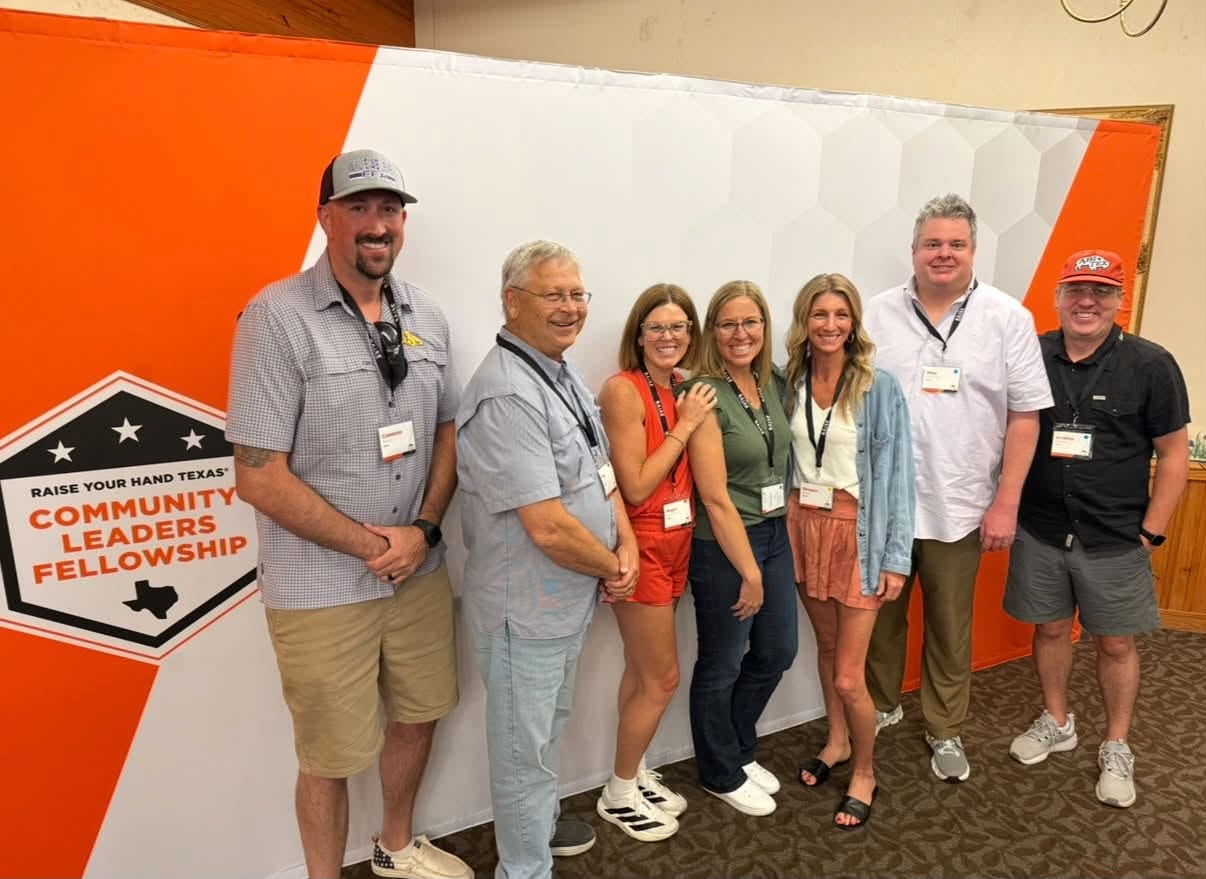
Local leaders traveled to Kerrville to better understand school finance, public education policy and how an informed community can help shape what comes next.
This past summer, representatives from Wylie ISD and the Wylie community spent several days in Kerrville participating in the Raise Your Hand Texas Community Leaders Fellowship. Wylie joined parents, educators, trustees, administrators and community members from across Texas to learn about public education policy, study school funding and prepare for conversations surrounding the next legislative session.
At the center of the fellowship was a simple idea: schools and communities are not on different teams.







Parents, teachers, support staff, administrators, students, trustees, business leaders and neighbors without children currently enrolled all have a stake in what happens inside local classrooms. Strong schools help build strong communities, and strong communities help schools succeed.
Trustee Cameron Wiley said Wylie’s participation gives the Big Country and West Texas a voice in statewide conversations. While districts across Texas share many of the same challenges, he noted that public education is not a one-size-fits-all system. Each community has its own students, priorities and story.
Understanding the Funding Puzzle
One of the biggest lessons from Kerrville was that local school boards do not determine the total amount of funding available for each student. The Texas Legislature establishes that amount through the school finance system.
Its starting point is called the basic allotment, which supports teacher pay and the daily work of operating schools. Additional funding is provided based on student needs, including special education, bilingual education and economic disadvantage. In 2025, the Legislature increased the basic allotment by $55, from $6,160 to $6,215 per student.
Lawmakers also approved $8.5 billion in new public education funding through House Bill 2, including money for teacher pay, support staff, special education and operating costs. That investment was meaningful. At the same time, Raise Your Hand Texas reports that Texas remains among the bottom 10 states in per-student funding and that inflation has reduced the basic allotment’s purchasing power by more than $1,000 compared with May 2019.
That statewide picture becomes even more noticeable when viewed close to home.
For context, an analysis of the Texas Education Agency’s 2024-25 actual PEIMS financial data found that Wylie ISD received approximately $10,930 in all-funds operating revenue per enrolled student. Compared with 1,012 traditional Texas districts reporting comparable data, Wylie was among the lowest 4 percent.
It helps families understand the financial landscape in which Wylie teachers, staff members and administrators are working. It also makes what happens here even more meaningful. Our schools continue to offer strong academic programs, fine arts, athletics, career training, transportation, counseling, safety services and countless opportunities for students while carefully stretching each available dollar.
Two Different Buckets
The fellowship also helped clarify an important distinction between operational funding and bond funding.
Operational dollars pay for the everyday needs of a school district, including salaries, utilities, fuel, classroom materials, technology support, maintenance and student services. Bond dollars are different. They are approved by voters and used for facilities, renovations and other long-term capital projects. Under Texas law, money collected to repay bonds cannot be used for routine operating expenses.
That makes the Wylie community’s support especially significant.
In 2023, voters approved a $240 million bond supporting new classrooms, labs, career and technical education spaces, athletic facilities and other improvements needed as the district grows. Those projects are providing safer, more modern learning environments and creating room for future Bulldogs.
The bond does not erase the challenges of operating revenue, and it cannot be used to increase salaries or cover day-to-day costs. But it does something tremendously important: it shows that this community believes in its schools and is willing to invest in the students who will walk through their doors for generations.
That kind of trust is never taken for granted.
Learning, Listening and Moving Forward
Trustee Megan Stephenson said the fellowship reinforced that local leaders must understand both what happens in schools and the policy decisions that shape them.
“Meaningful change happens when communities are informed, engaged, and willing to work together,” she said.
Community representative Bradley Benham left Kerrville with a similar perspective.
“The funding pie is not unlimited,” he said. “It is up to all of us to partner together to decide how best to slice and invest our dollars to make the biggest difference for every Bulldog in our school system.”
His biggest takeaway was even simpler: Texans may live in different places and support different schools, but they all love their children deeply. That shared love is not part of the problem. It is where solutions begin.
The fellowship emphasized that advocacy begins with listening, not arriving with a predetermined answer. Team Wylie learned strategies for holding community conversations, identifying shared priorities and following up so participants know their voices were genuinely heard.
Wylie will continue sharing what the team learned, not because anyone returned from Kerrville with every answer, but because informed communities make stronger decisions.
We may not always agree. That is part of being a community. But disagreement does not have to place us on opposing sides.
We remain one team, working toward safe schools, supported teachers, responsible stewardship and meaningful opportunities for every child.